
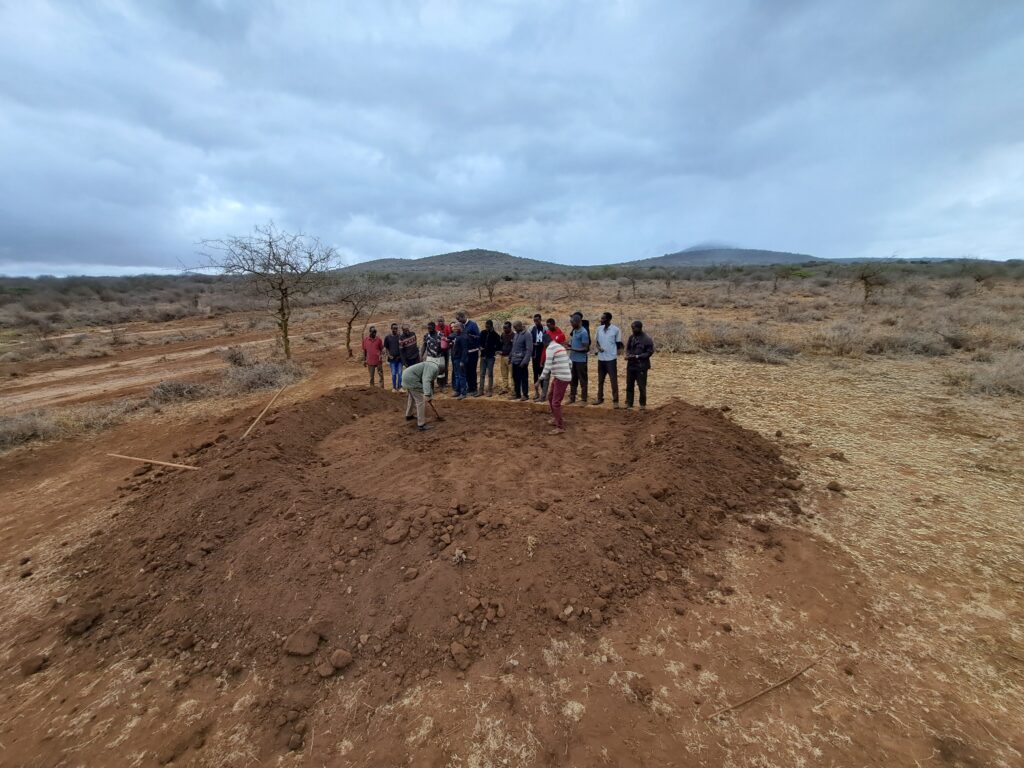


Another more frequent and persistent drought seems like an unlikely time to plant seeds in a semi-arid landscape of southern Kenya, and yet that was precisely what the community of Embolioi set out to do. On a cool November morning, a large number of volunteers with jembes listened to a brief description of how to dig a bundt, or “earth smile.” Imagine a half circle, about 2 meters across, the curved edge on the downhill side of the slope, and the straight edge catching small amounts of water behind a low, earthen dam.
“The earth smile created by the collective in now flourishing” – James Kamau, Founder, Millennial Environmentalist
The 30 volunteers quickly began to break the rough soil, and within 30 minutes a large earth smile took shape—not 2 meters across, but nearly 6. Hands and hoes scooped the now soft soil into the low barrier that would retain surface water for grass seeds to take root. The grass seeds were encased in small balls of charcoal to protect the seeds from birds, absorb the small amount of water captured in the bundt, and begin the germination process. All 30 of us each tossed those seed balls into the earth smile, before taking on our own, much smaller bundts adjacent to the Dukers Community Learning Centre.
This was certainly a day of community learning. We were combining the wisdom of the ancients, our lived experience and scientific research about how to create and sustain sources of grass for cattle in a challenging landscape. The thorny branches of acacia trees were thrown on top of each earth smile to protect the grasses in the first season of growth. And then a blessed rain came. First a few drops, then loudly beating on our heads, and on the metal roof. Perhaps these would be the long rains that would break the current drought. The next generation of seeds will come from the surviving grasses. The cycle of flourishing will continue.
30 months later, the communal earth smile is filled with robust grass. In April 2024, Kavita asked if the long rains could be collected from the roof to provide a source of water for the Dukers Community Learning Centre. That project was quickly followed by the nearby water pan, not 2 or 6 meters across, but 100 meters in size. And now, a borehole yields 3.5 cubic meters of water each minute, nearly a liter per second. Young girls, who spent hours each day walking for water, are able to come to school along with their peers to learn about themselves, their culture and the world. These approaches to cultivating collective flourishing began with the community learning centre, and are taking root in each household.
Share via: